|
Opening remarks - Bryan Pascoe, Chief Executive, ICMA)
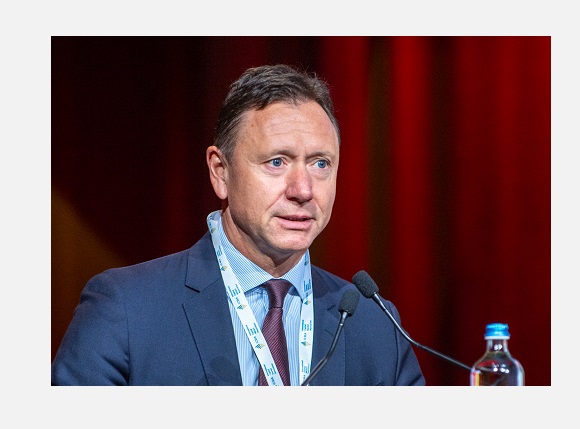
Following an amazing networking event last night at the Gare Maritime, ICMA chief executive, Bryan Pascoe, welcomed delegates back to the gold room at The Square conference centre for the final day of this year’s conference.
Panel discussion: The global fixed income landscape: The buyside perspective
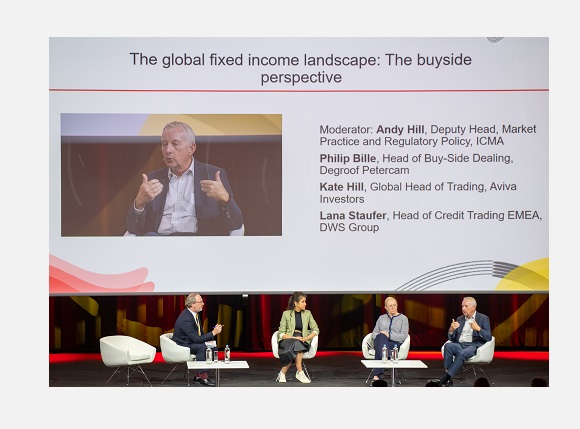
A strong start to our Friday agenda with our panel discussing the global fixed income landscape from the buyside perspective.
ICMA’s Deputy Head, Market Practice and Regulatory Policy, Andy Hill, moderated the panel of Philip Bille, Head of Buy-Side Dealing, Degroof Petercam, Kate Hill, Global Head of Trading, Aviva Investors and Lana Staufer, Head of Credit Trading EMEA, DWS Group.
Regulation, the impact of T+1, consolidated tape and the Basel 3 endgame were all on the table for analysis and debate.
In conversation: Stéphane Boujnah, CEO and Chairman of the Managing Board, Euronext N.V. and Stephane Malrait, Managing Director and Global Head of Market Structure and Innovation for Financial Markets, ING Bank
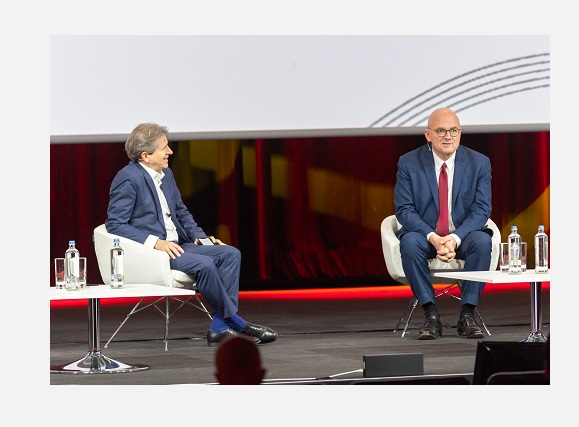
A fascinating and personal discussion with between Euronext CEO and Chairman, Stéphane Boujnah, in conversation with ICMA board member Stephane Malrait, Global Head of Market Structure and Innovation for Financial Markets, ING Bank.
M Boujnah has had an extraordinary career trajectory. He has been the CEO of Euronext and Chairman of the Managing Board of Euronext since 2015, joining the borse from his role as Head of Santander Global Banking and Markets for continental Europe.
The conversation explored the growth and consolidation of Euronext under Stéphane’s leadership, the successful acquisition of MTS and the Irish Stock Exchange, developments in post trade and clearing and the lessons learned from the failed merger attempt between the LSE and Deutsch Borse.
Keynote address: Aigboje Aig-Imoukhuede, Chairman, Coronation Group - The Africa Risk Premium: Unfair or Justified?
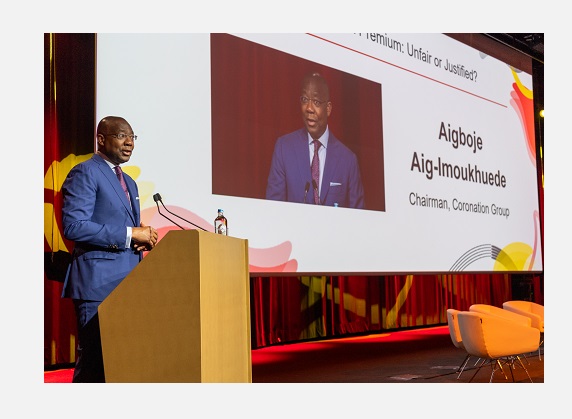 In our first keynote session of the day, Aigboje Aig-Imoukhuede, Chairman of the Coronation Group took to the stage to discuss developments in African capital markets. In our first keynote session of the day, Aigboje Aig-Imoukhuede, Chairman of the Coronation Group took to the stage to discuss developments in African capital markets.
Aigboje outlined the huge benefits that capital markets could bring to Africa, but highlighted the need to make African markets more efficient by integrating themselves with global financial markets, expanding their reach and providing investment opportunities where wealth is created. This is where markets can be a force for good.
In particular, Aigboje stressed that Africa has been left behind the prosperity that capital markets have brought to the modern world. He broadly put this down to sub-Saharan African issuers’ struggle to remain competitive on the global stage due to rating agencies’ reluctance to give investment-grade ratings – an unfair disadvantage and likely a mistake on their behalf.
This makes African sovereign debt more expensive, with African market participants often paying twice as much as competitors with the same rating.
Aigboje concluded by calling for improvements in African data and fiscal transparency and the adoption of global investment performance standards by sub-Saharan investment funds to put them on equal footing with international competitors.
In conversation: Vast opportunities and planetary need but little money - financing the response to climate change in emerging economies - Avinash Persaud, Special Advisor on Climate Change to the President of the Inter-American Development Bank and Ahren Lester, Assistant Editor, Environmental Finance
For our second ‘In Conversation’ session of the day, Ahren Lester, Assistant Editor at Environmental Finance sat down with Avinash Persaud, Special Advisor on Climate Change to the President of the Inter-American Development Bank to explore how to finance the response to climate change in emerging economies.
Building on the previous keynote delivered by Aigboje Aig-Imoukhuede, Avinash explained how risk premiums are obstructing the flow of capital to emerging markets and the need for Africa to unify to create a safe asset to avoid mass withdrawals from African markets during economic downturn.
He went on to discuss natural disaster clause bonds and discussed the why they need private sector acceptance.
Panel discussion: Cross border bond issuance and investment: Emerging market debt in focus
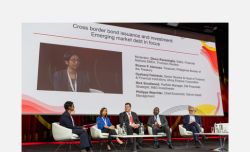
An excellent conversation focussing on cross border bond issuance and investment and emerging market debt, moderated by Thomson Reuter’s Financial Markets EMEA editor, Dhara Ranasinghe.
Delegates head from Sharon P. Almanza, Treasurer for the Philippines Bureau of the Treasury and Oyebanji Fehintola, Head of Treasury & Financial Institutions for Africa Finance Corporation.
M&G Investments’ Nick Smallwood from and Philippe Waechter from Ostrum Asset Management shared their buy side perspective.
Panel discussion: How to retain talent in today’s working reality: ICMA Future Leaders

In the Silver Hall, Tim Skeet, Chief Institutional Relationship Officer and Executive Management Committee Member for the Bank of China, led a panel discussion to discuss young talent in today’s financial services market.
The panel agreed that, although there are no issues with hiring amongst young people, there are problems with retention due to a shift in the demands of new generations – flexibility.
Panellists discussed how the new generations coming into financial services want to be heard and have an impact within the first few years of their careers. In addition to this, young people are demanding more flexibility to work when and where they want to, leading to lower rates of retention as young professionals leave the industry to find jobs that better suit their personal lives. Often the only thing keeping young people in finance jobs is compensation.
The panel concluded that, to bolster retention rates in the sector, management styles need to modernise to give young people exposure to a broader variety of working areas, and work-life flexibility must be prioritised to keep future industry leaders in the sector.
Keynote address: Professor Álvaro Cartea, Oxford-Man Institute and Mathematical Institute, University of Oxford - Reinforcement Learning: The applications and risks of using AI in the capital markets
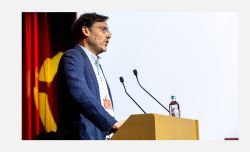
How likely is manipulation and collusion in electronic markets driven by AI?
Delegates heard from Professor Álvaro Cartea of the Oxford-Man Institute and Mathematical Institute, University of Oxford who really knows his brief.
His keynote on reinforcement learning and the applications and risks of using AI in the capital markets was detailed and a must-see for capital market professionals with an eye on the future use of this technology in their sector.
Professor Cartea spoke about his research which has found that manipulative algorithms learn how predictive signals work and how to manipulate those signals in the market to their advantage – otherwise known as spoofing.
They can also co-ordinate actions to achieve supra-competitive outcomes, effectively manipulating markets.
Machines don’t have a moral compass but will look for the optimal outcome dependent on their programming and the rules they are following. Brilliant, measured analysis of the likely impact of AI applied to financial markets for ICMA’s delegates.
In conversation: Marianne Demarchi, Chief Executive Europe, Middle East & Africa, SWIFT with Shruti Ajitsaria, Partner, Head of Fuse, A&O Shearman
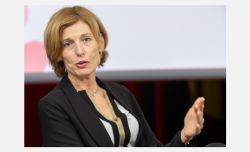
Next up: SWIFT’s Marianne Demarchi spoke about the organisations role as the industry’s ‘glue’, creating interoperability, connectivity and supporting new instruments and tokenisation, in conversation with A&O Shearman’s Shruti Ajitsaria.
Panel discussion: AI, digital assets in wholesale CBDCs: What are the opportunities and risks for bond markets?
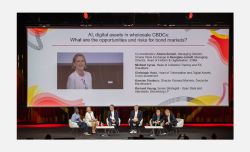
For the final panel of the conference, co-moderators Abena Amoah, Director at the Ghana Stock Exchange and Georgina Jarratt, Managing Director and Head of Fintech & Digitalisation at ICMA were joined by a host of experts to discuss the opportunities and risks in bond markets presented by AI, digital assets and wholesale CBDCs.
The group provided their working insights on digital bonds and how financial ecosystems need to adapt to allow new technologies to grow, moving completely from the sandbox stage into full-scale rollout.
They also explored wholesale CBDCs – and amidst rollouts across the globe – shared the work the EU is doing on a digital Euro and what it might look like.
Keynote address: Baroness Moyo, Member of the House of Lords, United Kingdom - The next moral hazard in financial markets: How regulators could act now to avoid an economic crisis later
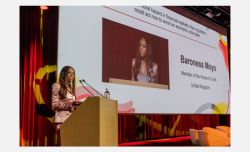
In a hugely insightful keynote this afternoon, Baroness Moyo, Member of the House of Lords of the United Kingdom, warned of the potential risks of a low interest rate market, and how regulators can act to avoid an economic disaster.
Baroness Moyo outlined that inflation in the UK, US and EU is moderating, evidence of deflation is rising in China, and global growth forecasts remain weak. This presents an imminent danger to capital markets and global economic activity.
In particular, Baroness Moyo highlighted that low interest rate markets tend to increase debt, which is now set to rise to record-level highs. A low interest, high debt market could also significantly reduce innovation, as the market sees less general activity and growth.
To avoid this outcome regulators must work with models that properly reflect the actions of the entire financial sector and their impact on the real economy. Regulators have the power to avert the next great economic crisis by acting now and planning ahead for a potential low interest rate market.
|


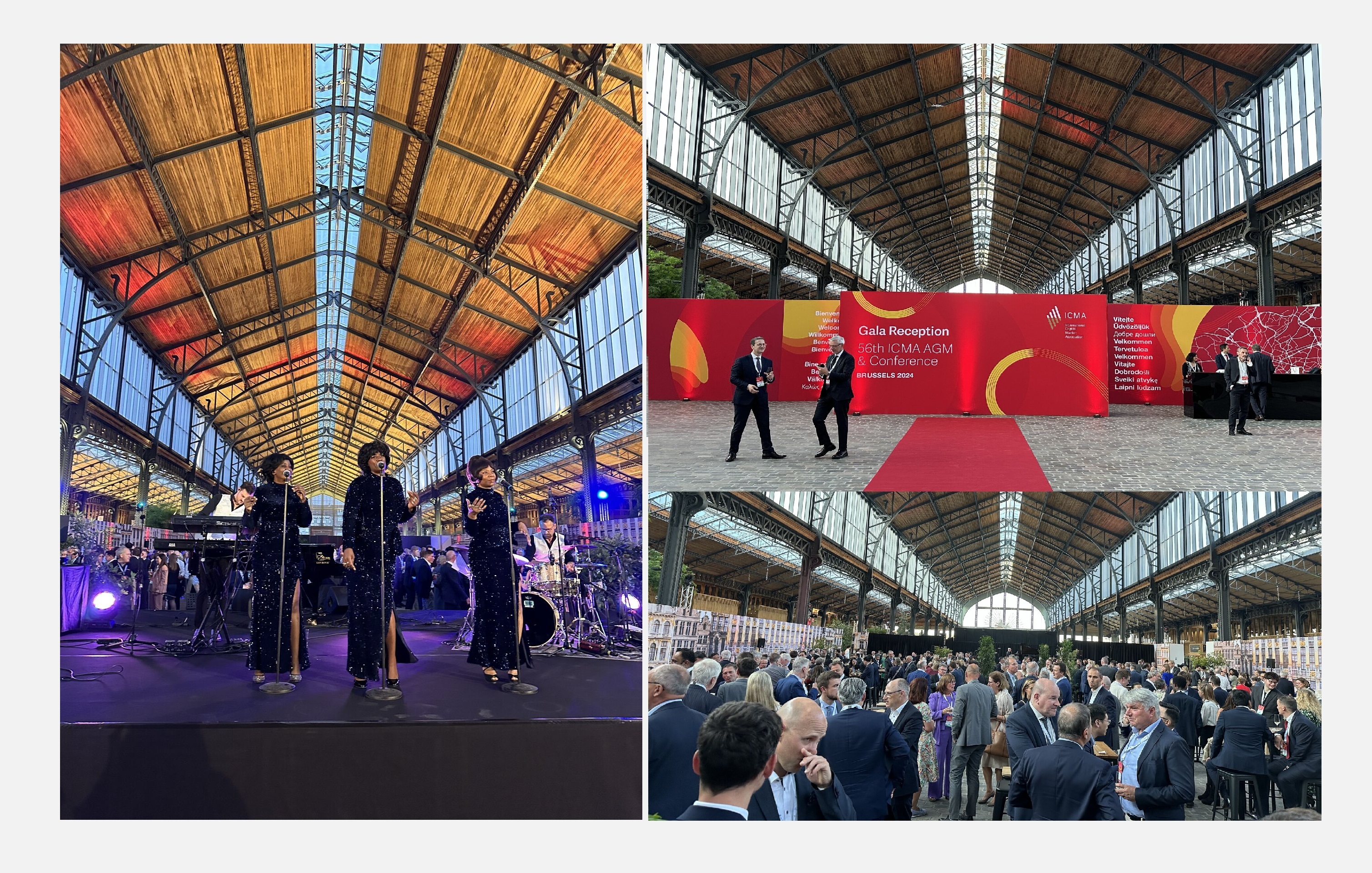 After a productive first day at the 56th ICMA AGM & Conference, delegates gathered valuable knowledge and exchanged innovative ideas.